Australian researcher achieves world-first spacecraft re-entry imaging breakthrough during international mission
Australian-developed imaging technology has achieved a world-first in spacecraft re-entry research, with University of Southern Queensland (UniSQ) researcher Dr Byrenn Birch successfully using a novel imaging system to capture a spacecraft breaking apart as it returned to Earth during an international mission over the Pacific Ocean.
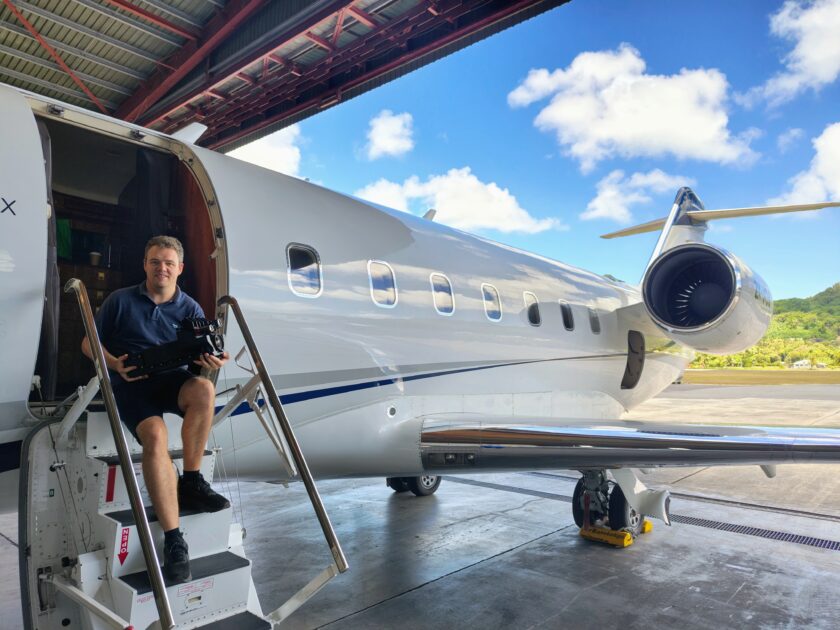
Dr Byrenn Birch, Senior Lecturer in Thermofluids Engineering at UniSQ, travelled to Rarotonga in the Cook Islands to participate in the KREPE-3 observation campaign, working alongside researchers from the University of Kentucky, University of Stuttgart and Zafiro Systems.
Supported by the Australian Government’s iLAuNCH Trailblazer program, the mission demonstrated a custom-built computed tomographic imaging spectrometer (CTIS), achieving a world-first by successfully using this advanced imaging technology to observe spacecraft breakup during atmospheric re-entry.
The 12 October 2026 mission observed the re-entry of 12 experimental capsules, including 11 developed by the University of Kentucky and one by the University of Stuttgart, designed to investigate how different spacecraft materials and thermal protection systems perform under the extreme temperatures and aerodynamic forces of atmospheric re-entry.
Based in Rarotonga due to its proximity to the predicted re-entry location, the international research team faced a challenging preparation schedule, with just two days to install the scientific equipment in the aircraft.
The team worked aboard a business jet, installing specialised imaging platforms, aligning instruments and configuring computers, GPS systems and timing equipment to ensure they could capture the brief re-entry event.
For Dr Birch, the mission represented an opportunity to demonstrate Australian-developed technology alongside leading international spacecraft re-entry researchers.
UniSQ contributed four instruments to the observation campaign, including the CTIS, a tracking camera, a conventional imaging spectrometer and a specialised filtered camera designed to detect carbon signatures associated with spacecraft breakup.
The CTIS instrument was the centrepiece of UniSQ’s contribution, offering a new approach to capturing detailed information about spacecraft as they break apart during re-entry.
Unlike conventional cameras, which record three primary colours, the UniSQ instrument can capture information across more than 500 colours simultaneously, allowing researchers to investigate the different materials and physical processes involved in spacecraft re-entry.
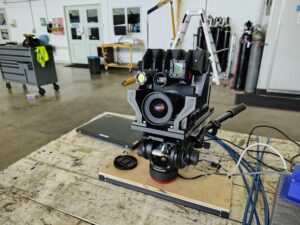 Image: Computed Tomographic Imaging Spectrometer (CTIS)
Importantly, the technology captures both spatial and colour information in a single image, overcoming limitations associated with traditional imaging spectrometers when multiple objects appear in the same field of view.
This is particularly important during spacecraft breakup, when several fragments may be visible at once and scientists need to distinguish the light emitted by individual objects.
The observation flight was successful, with all participating research teams locating the spacecraft shortly after it appeared over the horizon.
The successful CTIS observation represents a world-first achievement, demonstrating the potential of Australian-developed technology to support future international aerospace research.
Dr Birch said the mission highlighted the significant contribution Australian researchers could make to complex international aerospace campaigns.
“Australian researchers are not just participating in major international aerospace missions, we’re bringing technologies to the table that offer capabilities not available elsewhere. Seeing our instrument operate alongside international research teams was an exciting demonstration of what Australian research can contribute,” Dr Birch said.
While detailed analysis of the collected data is ongoing, the achievement opens opportunities to improve understanding of spacecraft breakup, material behaviour and the extreme conditions experienced during atmospheric re-entry.
The information could help researchers improve spacecraft design, refine re-entry prediction models and develop technologies that minimise risks to people and the environment.
Building on imaging technology developed through an Australian Research Council Discovery Early Career Researcher Award (DECRA), iLAuNCH supported its application in the international observation mission, helping translate advanced Australian research into real-world aerospace capabilities while strengthening international collaboration and demonstrating the potential of innovative technologies to address industry challenges.
The successful campaign highlights the value of investing in advanced research capabilities and international partnerships, while strengthening Australia’s position in hypersonics, spacecraft re-entry research and advanced imaging technologies.
The technology also offers potential applications in hypersonic flight testing, aerospace engineering and space situational awareness, creating opportunities for future research collaborations and industry engagement.
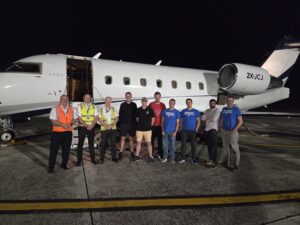 Image: Dr Byrenn Birch, Senior Lecturer in Thermofluids Engineering at UniSQ, alongside researchers from the University of Kentucky, University of Stuttgart and Zafiro Systems.
About the researcher – Dr Byrenn Birch
Dr Byrenn Birch is a Senior Lecturer in Thermofluids Engineering at the University of Southern Queensland’s School of Science, Engineering and Digital Technologies and is affiliated with the Institute for Space, Defence and Advanced Technologies.
Holding a Bachelor of Engineering and PhD from UniSQ, Dr Birch contributes to advanced aerospace research, including the development of specialised imaging technologies to observe spacecraft re-entry and investigate the extreme conditions experienced during hypersonic flight.
His contribution to the international KREPE-3 mission demonstrates the growing role of Australian researchers and technologies in major international aerospace campaigns.
About iLAuNCH
The Innovative Launch, Automation, Novel Materials, Communications and Hypersonics (iLAuNCH) Trailblazer is an Australian Government Department of Education Program led by the University of Southern Queensland in partnership with the Australian National University and Adelaide University. This program is building Australia’s enduring space capability through the commercialisation of projects, a fast-track accelerator, and skills development to build the workforce of the future.