
AI to monitor the health of astronauts, patients and remote workers
Monitoring the health of humans hundreds of kilometres above the Earth and in the infinite space beyond is a major challenge in the complex microgravitational environment of space. Australia’s own population, dispersed across a vast geographic landscape, offers a similar challenge to health professionals.
The ability to access real time data that could aid in precise diagnosis, predictive assessment, and, consequent treatments during human spaceflight could in turn save lives for those operating in isolated areas such as mining, defence, or those living in remote environments on Earth.
Australia is already a world leader in delivering medical care to remote regions. This iLAuNCH Trailblazer project will build on this expertise, transferring the capability to predict and monitor physiological changes to human spaceflight.
“I applaud Aspen Medical for making the leap into the demanding environment of space, and showcasing how space technology can help us here on Earth. It’s a great project led by the Australian National University, partnering with industry leaders including Saber Astronautics, Aspen Medical, and Liquid Instruments,” said iLAuNCH Trailblazer Executive Director, Darin Lovett.
Aspen Medical is one partner who will bring their significant experience in health response from around the globe to the Australian space industry. This collaboration is led by ANU who are developing medical digital twins, to rapidly simulate, diagnose and predict an astronaut or space passenger’s physiology in real-time and their fitness to fly and function in space.
ANU is partnering with an Australian innovator and manufacturer of field programmable gate array (FPGA) test equipment, Liquid Instruments, to develop and space qualify an integrated sensing-analysis-communication tool, alongside Saber Astronautics who will ensure its seamless communication.
“The analysis will be primed by algorithms informed by ANU digital twins and matured using medical science in combination with artificial intelligence tools such as machine learning in iterative field trials using real-life volunteer and patient data from intensive care units,” said project lead ANU Professor Klaus-Martin Schulte, MD, FRCS, FRACS.
“Our strategy envisions remote and isolated communities, and now Australian astronauts, having access to unobtrusive diagnostic tools that provide both patients and clinicians near-real time health data to aid in precise diagnosis and predictive treatments,” said Aspen Medical Founder and Executive Chair Glenn Keys AO.
“We will record and analyse a range of health measurements and integrate them into a predictive AI module. This module will have the capability to utilise multiple biomedical sensing systems to assess and predict health,” said Liquid Instruments, Chief Executive Officer, Professor Daniel Shaddock PhD.
Saber Astronautics will provide rideshare services for the tool on microgravity test flights. Saber will also ensure safe integration of data streams into mission control, via the Responsive Space Operations CentreTM (RSOC).
“Saber’s capabilities in space operations and microgravity testing will accelerate ANU and Liquid Instruments products and services into operational use for human health in space,” said Saber Astronautics, Chief Executive Officer, Dr Jason Held.
This project will not only be useful for spaceborne activities, it will bring direct and palpable benefits to Australians on the ground, as there is a huge opportunity to enhance health equity and conditions of remote patients and workers by providing them with real-time assessment and predictive health monitoring, with the potential for notification in case of a catastrophic health event. The combination of AI and advanced computing architectures, along with an understanding of measurements and their relation to human health, is fundamentally useful to all human beings and may be integrated into wearable products of the future.
About iLAuNCH
The Australian Government Trailblazer Universities Program provides dedicated investment to accelerate Australia’s innovation agenda at speed and at scale.
The Innovative Launch, Automation, Novel Materials, Communications and Hypersonics (iLAuNCH) Trailblazer is a $180 million program building Australia’s enduring space capability through the commercialisation of projects, a fast-track accelerator, and skills development to build the workforce of the future.
About ANU
The Australian National University is dedicated to provide our nation with research capacity amongst the best in the world, and education in areas vital for our future. It is committed to address the most complex of tomorrow’s problems.
About Aspen Medical
Aspen Medical is an Australian and veteran-owned global healthcare solutions provider with operations in Australia, the Indo-Pacific, the US, Europe, the Middle East and Africa delivering innovative healthcare solutions in complex environments, especially those that are remote, challenging or under-resourced.
About Liquid Instruments
Liquid Instruments delivers modern, software-defined test and measurement solutions that provide advanced capabilities, a great user experience, and custom programmability for maximum flexibility and performance in a range of applications.
About Saber Astronautics
Saber Astronautics’ mission is the Democratisation of Space, reducing barriers to space flight, and making space as easy as driving a car. Incorporated in 2008, Saber Astronautics flies and operates multi-tonne satellites, provides mission design services, and operations software. Saber has R&D laboratories and mission control centres in the USA and Australia, and with an advanced operational capability is a trusted supplier to both commercial and government space customers worldwide.
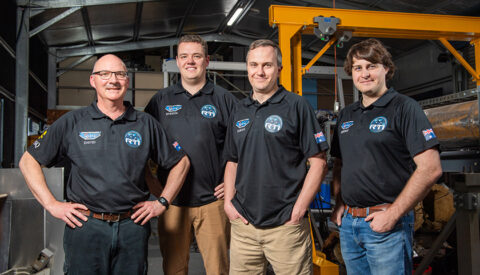
Pictured Top, Left to Right: Prof Daniel Shaddock, James Stuchbery, Prof KM Schulte, Ben Nizette.