Australia poised to lead innovation in optical satellite communications technology
The iLAuNCH Trailblazer program is set to revolutionise satellite communications in a new project that will develop technologies to give Australians faster and more affordable access to data.
Australia’s growing data demands are creating a strain on traditional radio satellite communication systems, which are already at full capacity. The global increase in data consumption, driven by everyday internet use, AI, and emerging technologies like cryptocurrency, is expected to grow by over 25% year on year. In 2022 alone, the average home internet user consumed 257 GB of data per month, and this figure is only set to rise. Australia, which relies on subsea cables and satellite communications through the radio spectrum for its international data exchange, faces mounting pressure to meet these increasing data demands.
This latest iLAuNCH project with The Australian National University (ANU) and its key partners, Optus and Leonardo UK, will see the team working together to build smaller, lower cost laser communications ground stations that will bypass the radio bottleneck. Optical satellite communication technology has the potential to significantly increase data transmission rates, enabling a substantial increase in data return directly to Earth. Once in operation, these compact, low-cost ground stations and miniaturised, low-power onboard terminals will make downlink-to-Earth communications commercially viable.
“This project is redefining the way things have always been done, demonstrating how Australian innovation and collaboration is unlocking new opportunities in the global space industry. By progressing from radio to optical communication technology, we are positioning Australia as a leader in NewSpace satellite communications,” said iLAuNCH Trailblazer Executive Director, Darin Lovett.
“It’s a clear demonstration of how iLAuNCH are building sovereign capability in the critical field of global communications while providing valuable support for local companies and researchers that will ultimately lead to exports and commercialisation.”
A current challenge with the effectiveness of getting data through lasers from space to the ground, is atmospheric interference, the same effect that causes stars to twinkle. This degrades the ability to transmit data. Taking inspiration from our world’s oldest astronomers, this project will use stargazing techniques that “de-twinkle” stars at ground-based observatories to ensure that laser communication terminals can achieve maximum bandwidth.
One of the major breakthroughs of this project will be the development of a highly sensitive, high-bandwidth optical data receiver, designed for photon-starved environments. This technology will support quantum key distribution (QKD) and other high-performance communication protocols.
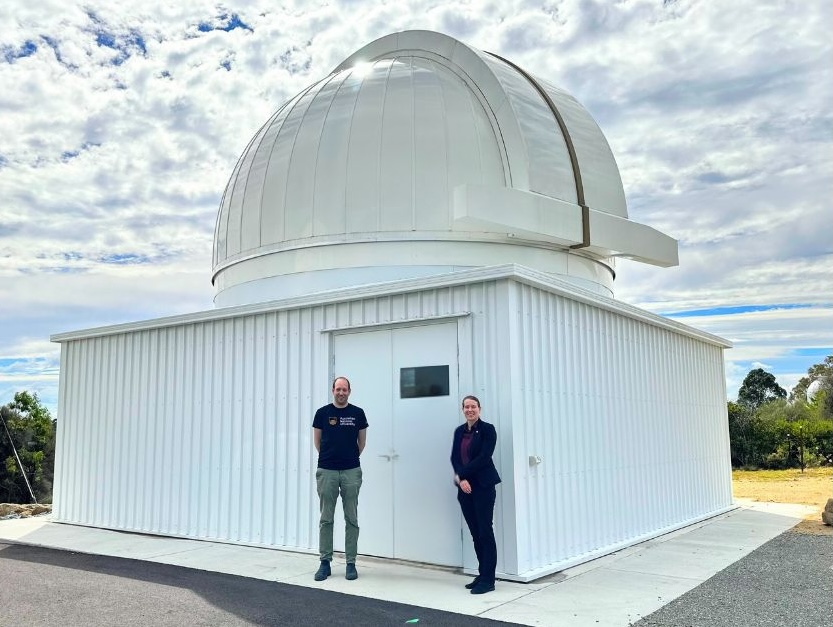
“Australian National University’s extensive experience in building complex optical instruments is currently being applied in the construction of an optical ground station (OGS) at the Mount Stromlo Observatory in Canberra, demonstrating Australia’s capability to lead in this field. Leveraging the university’s expertise in adaptive optics, optical communications, and instrumentation, the project will design and scale adaptive optics (AO) systems for commercial and military satellite operators with significant market potential,” said ANU Research School of Astronomy and Astrophysics, Associate Professor Francis Bennet.
Pictured: ANU team Marcus Birch, Kate Ferguson, Michael Copeland, Elisa Jager and Francis Bennet inside Mount Stromlo Observatory in Canberra.
ANU will also site-test Optus’s Belrose Space Operations Centre to inform potential future laser optical ground station options. Additionally, this project will support two PhD positions at ANU, providing researchers with hands-on experience in advanced optical communication technologies and contributing to the development of Australia’s space capabilities.
This initiative is backed by key industry and international partners:
- Optus, Australia’s 2nd largest telecommunications company, will demonstrate both the AO and detector systems using current and future satellite infrastructure, enabling new commercial pathways in optical communications.
- Leonardo UK is contributing compact optical detectors (OptiTrax) capable of acquisition, tracking, and communication in photon-starved conditions. These detectors will be integrated with Adaptive Optics (AO) systems to create advanced optical data receivers for space platforms.
This iLAuNCH project aims to develop a space-to-Earth laser communication ground station capable of data transmission rates vastly exceeding the current capabilities of radio-based satellite systems, with the potential to reach Terabits per second using the technology developed in this project. The technology could provide Australians with more options for connectivity with laser communications also offering inherent advantages such as high security, immunity to jamming, and the ability to serve remote and rural areas with high-speed internet. With smaller ground stations that can be spaced closer together, laser communications have the potential to transform Australia’s connectivity landscape.
This project represents a significant step forward in space communications, with far-reaching implications for industries such as defence, telecommunications, and beyond. By collaborating with leading global and national partners, iLAuNCH and ANU are poised to position Australia at the forefront of optical satellite communications innovation.
To find out more about the two PhD positions, visit ANU Scholarships.
Quotes attributable to Industry Partners:
Matthew Hicks, Space Programme Manager at Leonardo said, “Leonardo UK, is developing detectors suitable for optical communications including a compact detector the SAPHIRA which will combine the function of initial acquisition and tracking as well as communications receiver in the photon-starved regime. This project will accelerate the development of these detectors, by integrating and packaging them with compatible optics into an advanced optical data receiver instrument to demonstrate optical communications from a space platform.”
Nick Leake, Head of Satellite and Space Systems at Optus said, “Optus is excited to be collaborating with the students and Faculty of the Australian National University and iLAuNCH on the Trailblazer program to research and discover the possibilities that can be unearthed through the use of Optical Laser Communication. Australia is full of innovation, particularly in the space industry and it’s critical that established players like Optus continue to collaborate with other local companies and universities to push the boundaries beyond where the currently sit. Australia’s large landmass makes it an ideal place for much activity in the space ecosystem, particularly hosting satellite ground stations. As more technology moves beyond our atmosphere, research like this will become key in how industry keeps up with innovation.”
About iLAuNCH
The Innovative Launch, Automation, Novel Materials, Communications and Hypersonics (iLAuNCH) Trailblazer is an Australian Government Department of Education Program led by the University of Southern Queensland in partnership with the Australian National University and the University of South Australia. This program is building Australia’s enduring space capability through the commercialisation of projects, a fast-track accelerator, and skills development to build the workforce of the future.
About ANU
The Australian National University (ANU) is dedicated to provide our nation with research capacity amongst the best in the world, and education in areas vital for our future. It is committed to address the most complex of tomorrow’s problems. ANU has world-leading capability in optical communications for satellite applications and has made significant investment in the ANU optical ground station (OGS), the most advanced OGS in Australia. During this project, ANU will provide access to the ANU OGS and instrumentation to accelerate our partners’ advanced communications technology.
About Leonardo
Leonardo Space technologies are present in many major international missions, including those focused on remote sensing for Earth observation and weather phenomena, as well as space exploration, communication and navigation systems. The company’s capabilities include the production of high-tech equipment and sensors, and the management of satellite services.
About Optus
Optus is Australia’s most experienced satellite owner and operator, with satellite services across Australia, New Zealand and with availability to McMurdo Sound in Antarctica. Optus is Australia’s second largest telecommunications company, providing services through its national mobile networks, fixed networks and geostationary satellites.
Optus work closely with global suppliers and continue to be at the forefront of utilising cutting-edge space technology and employing, as well as training, highly skilled space talent.
Optus’ main satellite operations centre is located in Belrose, on the outskirts of Sydney. Optus also have other operation stations in Lockridge (WA), Hume (ACT) and Regency Park (SA).
From these stations, Optus conduct 24/7, 365 day-a- year satellite network monitoring, support and troubleshooting across a range of industries – as well as continuous video, voice and data delivery.