Licence plate optical beacon to improve satellite tracking
As the global space industry expands and satellite launches surge, the challenge of accurately identifying individual satellites has become increasingly complex. In response, the latest iLAuNCH Trailblazer project is set to revolutionise satellite identification by introducing a novel approach that integrates near-infrared (IR) LED beacons, ground-based optical telescopes, and Non-Earth Imaging (NEI) technology.
Currently, radar and non-resolved optical observations offer limited precision, particularly in distinguishing satellites on similar orbital paths. As of August 2024, over 700 satellites remain unidentified, a problem exacerbated by ride-share missions that deploy multiple satellites into the same orbit simultaneously. This project will demonstrate a scalable solution that improves identification accuracy and enhances space situational awareness.
Our solution introduces an infrared “licence plate” beacon attached to a demonstrator satellite. This beacon will emit near-infrared light, which can be detected by ground-based telescopes across the globe.
“Our project presents a game-changing approach to satellite identification by leveraging existing infrastructure to provide a cost-effective and scalable solution. By combining ground-based and space-based technologies, we aim to deliver precise identification that will be invaluable for commercial, defence, and intelligence applications,” said Dr Joni Sytsma, Chief Technology Officer at iLAuNCH Trailblazer.
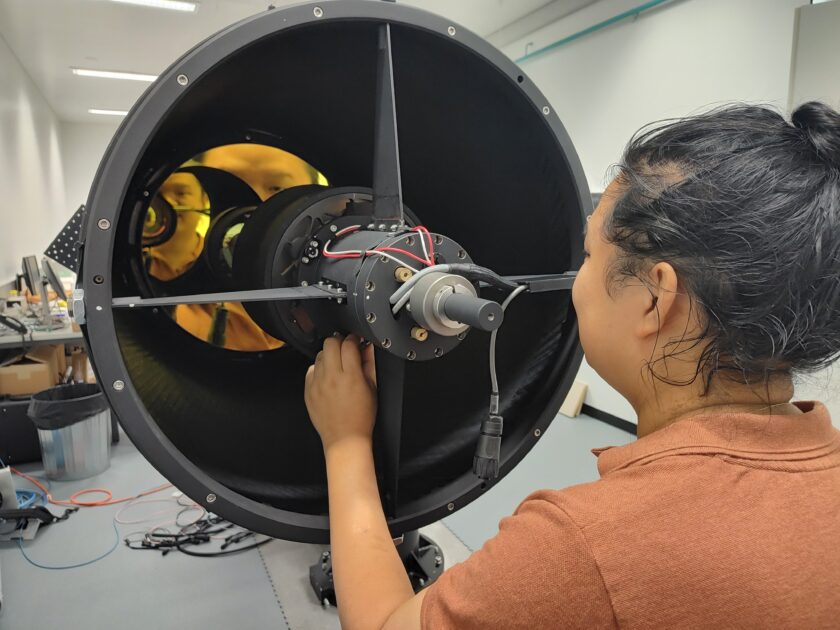
The project will upgrade The Australian National University (ANU) DREAMS telescope at Siding Spring Observatory to detect an infrared beacon mounted on a demonstrator satellite. The ANU will also develop a Near-Infrared (IR) LED Beacon, designed for seamless integration with small satellites. Emitting near-infrared light, the beacon will be detected by a global network of ground-based telescopes, enabling initial detection and coarse positioning of satellites.
“This project showcases ANU’s expertise in astronomical technology and space situational awareness. By upgrading our DREAMS telescope and developing a compact, adaptable IR LED beacon, we are paving the way for improved satellite tracking and identification,” said Associate Professor Tony Travouillon, Associate Dean of The Australian National University College of Science.
HEO, a leader in Non-Earth Imaging (NEI), will provide critical capabilities to refine identification further. After initial detection from the ground, HEO will utilise its network of over 40 in-orbit cameras to capture high-resolution images of the satellite. Once collected, the images will be transferred to HEO’s software platform, HEO Inspect, where proprietary tools will analyse the visual data, focusing on distinctive features such as size, antenna structures, and solar panel configurations, allowing for precise identification.
“HEO is adding a new data source at scale with non-Earth imaging (NEI). We know this technology is critical for monitoring spacecraft in orbit and we’re excited to work with fellow Australian organisations to test the effectiveness of integrated IR LED beacons, ground-based telescopes and in-orbit cameras for satellite identification. This could transform the way we think about space situational awareness,” said Dr William Crowe, Co-Founder and CEO of HEO Robotics.
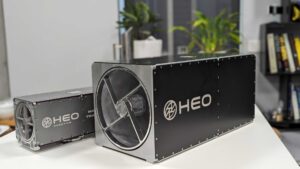 HEO’s NEI cameras – Holmes and Adler
Additionally, ANU’s IR LED beacon will be supported by an independent satellite module built by ANT61, the Australian company that specialises in satellite communications, diagnostics, and recovery. This module, known as the Beacon M, will provide the mission with independent control of the IR LED beacon, ensuring seamless functionality both within, and separately from existing satellite systems. Boasting an independent power supply, the Beacon M integration minimises risk and maximises mission assurance by enabling recoverability in the unlikely event of a primary satellite system anomaly.
“We’re proud that the Beacon M will help revolutionise satellite identification as part of this mission. Our Beacon range can be easily integrated into satellite platforms, ensuring greater dependability in making this ‘license plate’ technology widely accessible across the industry,” said Mikhail Asavkin, Founder and CEO of ANT61.
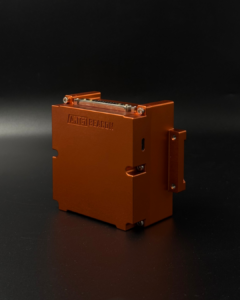 ANT61 Beacon M
By leveraging existing ground-based telescopes and HEO’s in-orbit imaging network, this project eliminates the need for costly dedicated tracking infrastructure, making satellite identification more accessible and scalable. The demonstration mission in 2027 will validate the technology with a beacon mounted on a commercial satellite, proving its value for early adopters in defence, intelligence, and commercial sectors.
This initiative underscores Australia’s growing capabilities in space situational awareness and satellite tracking, reinforcing its position as a leader in cutting-edge space technologies.
About iLAuNCH
The Innovative Launch, Automation, Novel Materials, Communications and Hypersonics (iLAuNCH) Trailblazer is an Australian Government Department of Education Program led by the University of Southern Queensland in partnership with the Australian National University and the University of South Australia. This program is building Australia’s enduring space capability through the commercialisation of projects, a fast-track accelerator, and skills development to build the workforce of the future.
About HEO
HEO is a non-Earth imaging company that delivers on-demand, high frequency imagery and insights on the most important assets in space. HEO is building out a network of NEI sensors by partnering with Earth observation satellite constellations and launching own cameras as hosted payloads to achieve proliferation of NEI sensors across all orbits in the Earth-Moon system. HEO deploys highly autonomous software to monitor spacecraft at scale for government, defence, and commercial customers. HEO is headquartered in Australia with offices in the UK and USA.
About ANT61
ANT61 is an Australian company that specialises in satellite communications, diagnostics, and recovery, providing advanced solutions for both commercial space operations and defence applications. Their range of Beacon products is engineered for seamless integration into existing satellite systems, with a non-ITAR design that allows for easier global deployment. Featuring robust inter-satellite communication capabilities and independent command and control, the Beacon ensures continuous operation even in the event of a primary system anomaly. By delivering real-time telemetry recovery capabilities, the Beacon mitigates risk and maximizes mission assurance—all with minimal disruption to existing infrastructure. Based in Sydney, Australia, the company also develops other AI based control systems for the harsh space environment.