Long-range imagery to capture rockets in flight
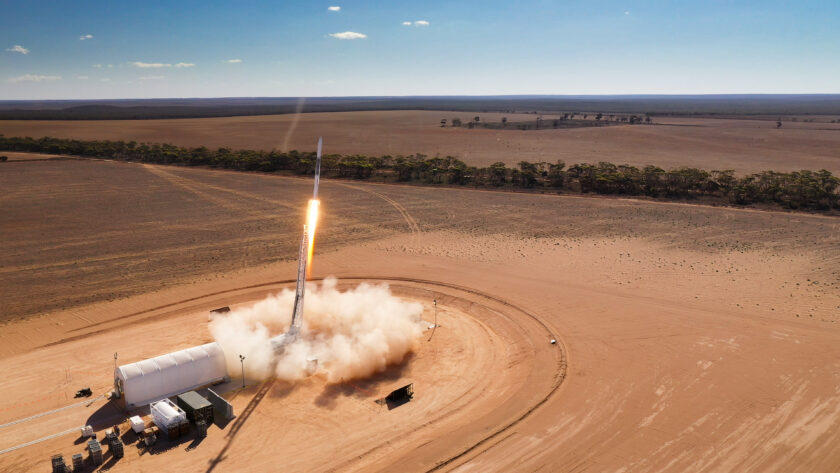
T-10 minutes and counting; the anticipation of a rocket about to blast off into space from a launch pad somewhere on Earth paints a picture in all of our minds.
The spectacular imagery of a rocket launching provides space enthusiasts with real out of this world action, but we know it’s not just for entertainment purposes. Launch providers require data and imagery on the launch vehicle and its trajectory from lift off, ignition, to fairing and payload separation and finally achieving orbit. Or in the case of a failed launch, images to understand the causes.
Australia’s aerospace industry currently has limited long-range imaging capability with tracking done over radar, which ultimately means our launches have not had the same high quality capture of imagery as those internationally.
While Australia is developing a commercial launch industry, having access to quality shareable imagery on launch is essential to support this growth.
In this latest iLAuNCH Trailblazer project, the University of Southern Queensland is partnering with Southern Launch to develop long range imaging capability to gather high-quality, high-resolution data and images of rocket launches at their launch facilities.
“If you’re a fan of launch videos from YouTubers like Marcus House or Scott Manley, have you ever thought about how those amazing images were taken?” said iLAuNCH Chief Technology Officer, Joni Sytsma.
“Using UniSQ’s expertise in imaging launch vehicles, re-entry capsules and hypersonic flight, we expect to see live imagery of rocket launches from Southern Launch facilities in South Australia in the next year.”
Research will be undertaken at UniSQ over the next three years that will develop the capability to track and triangulate rockets and high-speed tests at Southern Launch ranges.
“We are excited at the prospect of providing scientific data to Southern Launch to assist with operational safety and evaluation purposes and a future potential service offering to their customers,” said University of Southern Queensland’s Associate Professor Fabian Zander.
The project will develop imaging systems along with the tracking and data fusion systems that permits us to follow the rocket on the way up, allowing us to capture exceptional quality video and imagery. This imagery can be used for publicity purposes, or in the event of an incident, provide important information for analysis.
“We welcome this iLAuNCH Trailblazer project with UniSQ. The project will support our team to track objects launching or returning to the Koonibba Test Range or the Whalers Way Orbital Launch Complex which is vital to ensure we achieve the best outcomes for our customers. We also look forward to being able to share high quality video and images with the general public of the missions that take place at the range,” said Southern Launch Chief Executive Officer, Lloyd Damp.
There will be a minimum of one imaging opportunity per year that will enable the subsystems to be tested and validated throughout the project until 2027.
About iLAuNCH
The Australian Government Trailblazer Universities Program provides dedicated investment to accelerate Australia’s innovation agenda at speed and at scale.
The Innovative Launch, Automation, Novel Materials, Communications and Hypersonics (iLAuNCH) Trailblazer is a $180 million program building Australia’s enduring space capability through the commercialisation of projects, a fast-track accelerator, and skills development to build the workforce of the future.
The University of Southern Queensland’s Institute for Advanced Engineering and Space Sciences’ Hypersonics and Rocketry team conducts research for a variety of funding bodies including defence and aerospace industries through domestic and international collaborations in the United Kingdom, Europe and USA.
Through expertise in ground testing, optical remote diagnostics, and modelling and simulation, the group has an extensive research track record spanning the full spectrum from fundamental hypersonic research to hypersonic vehicle applications.
About Southern Launch
Southern Launch provides bespoke launch and return services in the Southern Hemisphere with end-to-end launch support for our customer’s next mission.
Southern Launch offers two unique spaceports in South Australia designed to support different launch and return requirements. The Whalers Way Orbital Launch Complex is one of the only sites in the world that can provide high-cadence launches to polar and sun-synchronous orbits. The Koonibba Test Range is the largest commercial rocket testing facility in the Southern Hemisphere and specialises in suborbital launches and returns from space.
Working closely with customers, they find the most cost-effective path to safe, successful, and frequent launch and takes carriage of all of the details from regulatory approval to logistics, on-range set up and launch support.