UniSQ launches hypersonic flight experiment with the German Aerospace Center (DLR)
A new hypersonic flight experiment developed under the iLAuNCH Trailblazer Fast Track Program has successfully launched as part of the German Aerospace Center’s (DLR) MAPHEUS-16 mission, marking another major milestone for Australian space research.
The GAsFEx-2 (Germany Australia Flight Experiment) project is led by the University of Southern Queensland (UniSQ) in collaboration with the Technical University of Munich (TUM), the DLR’s Mobile Rocket Base (MORABA), and Queensland-based aerospace startup HyperFlight Systems.
The experiment aims to establish a flight-proven capability for cost-effective hypersonic testing, offering a novel “ride-along” approach that allows small aerothermodynamic experiment payloads to share sounding rocket missions. This approach significantly reduces the cost and complexity of hypersonic flight testing by as much as 95% compared to traditional standalone rocket missions.
Building on the GAsFEx-1 flight in 2024, the latest mission incorporates enhanced avionics and improved measurement and recovery mechanisms to strengthen the platform’s capability for future commercial and research applications.
The successful launch and recovery of GAsFEx-2 represents a major outcome of the iLAuNCH Trailblazer Fast Track Program, which accelerates high-impact projects between industry and research to advance Australia’s sovereign space capability.
“This successful flight is a key step toward making hypersonic flight testing more accessible, affordable, and reliable,” said Professor Ingo Jahn, project lead at UniSQ’s Hypersonics and Rocketry Group. “By demonstrating our ability to design, manufacture, and fly ride-along hypersonic payloads, we’re opening new opportunities for industry and academia. Flight data is critical in the development of hypersonic technology – to validate systems, evaluate new materials, or test theoretical models and computational simulation tools.”

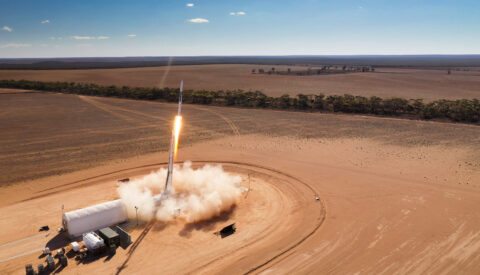
Image: In the early morning hours of 12 November 2025, the MAPHEUS-16 sounding rocket successfully lifted off from the Esrange launch site, carrying 21 experiments into microgravity for just over six minutes.
The collaboration with DLR’ MORABA provided access to the forward nosecone of the MAPHEUS-16 payload, where the UniSQ-led team integrated their avionics and measurement system to monitor flight conditions and measure temperatures at hypersonic flight speeds during the ascend phase of the vehicle.
Marcus Hörschgen-Eggers from DLR MORABA explains: “Within DLR’s well-established sounding-rocket program MAPHEUS, MORABA investigated into a possibility to enhance in-flight measurements with focus on aerothermodynamic parameter. In order to facilitate the integration of additional measurement units into the experimental payload infrastructure special attention was set on the autonomous design of the rideshare experiment without interfering with the main payload. In close collaboration with UniSQ, the GAsFEx measurement system was integrated and function tested at MORABA facilities before the launch mission commenced. The partnership with the Technical University of Munich (TUM) closes the loop towards the numerical monitoring of the in-flight measurements resulting in a unique and valuable joint data set.”
Industry partner HyperFlight Systems contributed avionics hardware and design expertise to the project, gaining flight heritage for newly developed systems designed for hypersonic applications.
“This collaboration provides a platform for us to prove new avionics designs in a relevant hypersonic environment,” said Robet Pietsch, Principal Engineer of HyperFlight Systems. “Working alongside UniSQ and international partners not only accelerates our product development but also strengthens Australia’s aerospace capability by building local expertise in hypersonic flight systems.”
The successful flight establishes UniSQ’s capability to offer complementary flight test and ground testing for hypersonic technology development. Hypersonic flight conditions experienced in the atmosphere during GAsFEx can be matched in UniSQ’s hypersonic wind tunnel TUSQ, enabling correctly scaled flight conditions in ground testing. The project team is creating one of the few integrated hypersonic validation pathways in the world, cementing UniSQ’s position as a global leader in hypersonic research.
Recent Publication:
> Germany Australia Flight Experiments GAsFEx-2: Progress Update and Preliminary Results: https://arc.aiaa.org/doi/10.2514/6.2026-5063
About iLAuNCH
The Innovative Launch, Automation, Novel Materials, Communications and Hypersonics (iLAuNCH) Trailblazer is part of Trailblazer Universities Program administered by Australian Government Department of Education. ILAuNCH is led by the University of Southern Queensland in partnership with the Australian National University and the University of South Australia. This program is building Australia’s enduring space capability through the commercialisation of projects, a fast-track accelerator, and skills development to build the workforce of the future. To find out more, visit ilaunch.space.
About Hypersonics and Rocketry at UniSQ
The Institute for Advanced Engineering and Space Sciences’ Hypersonics and Rocketry team conducts research for a variety of funding bodies including defence and aerospace industries through domestic and international collaborations. Through expertise in ground testing, optical remote diagnostics, and modelling and simulation, the group has an extensive research track record spanning the full spectrum from fundamental hypersonic research to hypersonic vehicle applications.
About HyperFlight Systems
HyperFlight Systems (HFS) is a Brisbane-based aerospace startup specialising in the design, development, and manufacture of advanced avionics systems for research and high-speed flight applications. HFS partners with universities and industry to deliver innovative, flight-proven solutions for hypersonic and experimental aerospace projects.
About the German Aerospace Centre (DLR)
The German Aerospace Center (Deutsches Zentrum für Luft- und Raumfahrt; DLR) is Germany’s national research and technology centre for aeronautics, space, energy, transport, security and defence. DLR’s work spans a wide range of applications, delivering results and innovations that benefit industry and business, government agencies and the public sector. Its Mobile Rocket Base (MORABA) is a world-leading facility for launching sounding rockets – thus enabling experiments in microgravity conditions, hypersonic flight, and atmospheric research as well as technology testing and education.
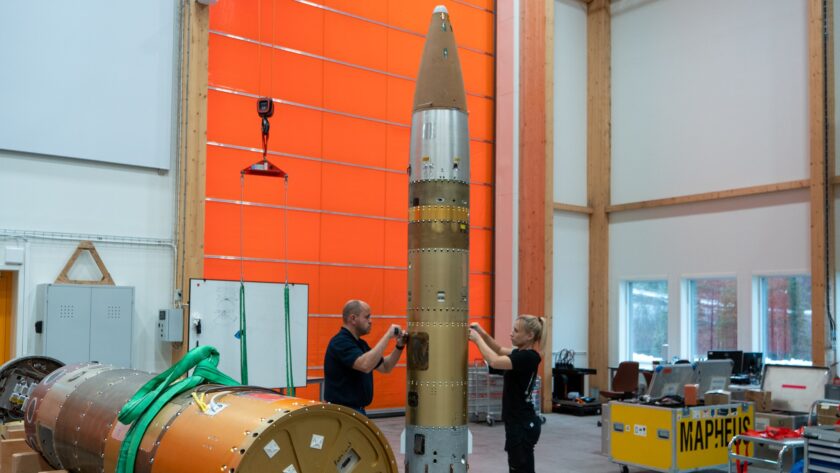
Main image caption: Preparing the payload for MAPHEUS-16. DLR’s MAPHEUS-16 sounding rocket carried approximately 500 kilograms of scientific payload – a new record for the programme.