Universities and industry unite to detect hypersonic threats from space – project highlighted at Indo Pacific 2025
A collaboration between Australian universities and industry is taking shape through the iLAuNCH Trailblazer, with the goal of developing a sovereign space-based sensing system capable of detecting hypersonic threats from orbit.
The Space-based Sensor for Hypersonic Missile Early Warning project will design and demonstrate an advanced small-satellite system combining infrared detection technology with artificial intelligence (AI) and machine learning (ML). The result will be faster, more accurate detection of hypersonic vehicles, a critical capability for Australia’s national security and a key focus under AUKUS Pillar II technology cooperation.
Bringing together expertise from the Australian National University (ANU), University of Southern Queensland (UniSQ), Adelaide University (AU), Spiral Blue, and Northrop Grumman Australia, this project unites the nation’s best research and industry expertise to develop sovereign space-based early warning technologies.
“The iLAuNCH Trailblazer is a powerful example of how Australian industry and academia can come together to deliver sovereign capability in space-based sensing and hypersonic threat detection,” said Rob Denney, Northrop Grumman Australia Country Executive.
Each partner brings specialist strengths to the challenge. ANU will lead the design of the satellite-based sensor system, UniSQ will model the aerothermal emissions and flight dynamics of hypersonic vehicles, AU will apply AI and ML techniques for signature recognition, Spiral Blue will provide on-board space-edge computing hardware and Northrop Grumman Australia will undertake mission engineering and validate operational concepts in a synthetic testbed.
Industry Professor Colin Hall from Adelaide University said “the collaboration gives researchers the opportunity to apply advanced AI and machine learning to one of the most demanding sensing challenges in defence.”
“The collaborative nature of the iLAuNCH Trailblazer has brought industry and all three universities together to address this complex challenge,” Professor Hall said. “Adelaide University are able apply its AI/ML capabilities to hypersonic signature recognition in this critical project.”
At the University of Southern Queensland, Associate Professor Fabian Zander of the Hypersonics department, said UniSQ’s expertise in high-speed flight aerothermodynamics will help shape how hypersonic vehicles are detected from orbit.
“Our role focuses on understanding the aerothermodynamics of hypersonic vehicles to better inform detection from orbit,” Associate Professor Zander said. “This is a unique opportunity to combine UniSQ’s hypersonics knowledge with national efforts in space-based defence technology.”
Australian National University’s contribution to sensor design leverages its decades of experience in delivering advanced, high-precision and complex astronomical optical instruments through international and industry collaboration.
“ANU brings deep expertise in electro-optical systems and satellite payload development to this mission,” Dr Joice Mathew of the ANU Research School of Astronomy and Astrophysics, said.
“We are committed to ensuring Australia has the sovereign capability to design, build and operate advanced space sensors that can detect emerging threats from orbit.”
Matt Opie, CEO of Defence SA and the South Australian Space Industry Centre, said the project demonstrates how collaboration across states and sectors strengthens national capability.
“South Australia is at the forefront of defence and space innovation, and this project demonstrates our leadership in artificial intelligence and machine learning,” Mr Opie said.
“Through strong national collaboration across industry and academia, we are harnessing our strengths in space to drive the development of novel space technologies and sovereign capabilities to safeguard Australia from emerging threats.”
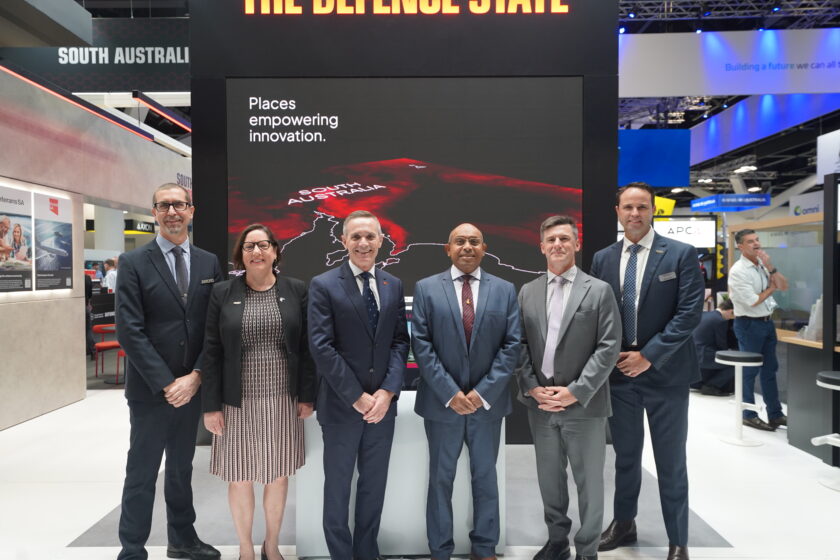
Initially announced in August 2024, the project was showcased at the South Australia stall at Indo Pacific 2025 as a significant UniSA-led project under the $180 million iLAuNCH Trailblazer, which is funded by the Australian Government’s Trailblazer Universities Program to accelerate space capability, technology commercialisation and workforce development.
Image (L to R): Industry Professor Colin Hall from AU, Deanne Barnett from Northrop Grumman Australia, Matt Opie from DefenceSA, Dushy Tissa from Northrop Grumman Australia, Robert Denney from Northrop Grumman Australia and Jake Adams from Northrop Grumman Australia.