An industry first – Intuitive Machines lands on the Moon
Insights on the first industry lunar lander from iLAuNCH CTO, Dr Joni Sytsma
Only eight years ago, SpaceX proved that a private company could out-innovate decades of governmental space programs and achieve something that everyone at NASA had, until that time, assumed was impossible: landing a rocket vertically. That singular technological feat has shifted the entire landscape of space and access to it by bringing down the cost considerably through reusability and allowing the productivity gains of private industry and the scale and speed at which it can act. Space will never be the same again, and every rocket company in the world now has a higher bar to meet to ensure that they have to be reusable in order, and if they aren’t, they are doomed for failure.
We are now at a time in history where similar access to the Moon is up for grabs. It’s once again the likes of private industry who will prove that they can do it better than government programs would have done at a lower cost and faster cadence. The 2020s have shown that private industry and the Moon can come together for great effect. The past few years have shown an absolute influx of new lunar landers being demonstrated, and although not all of them are successful, the race to stake claim to the Moon is inevitably going to, very soon, have winners and losers.
Intuitive machines, funded under a recent NASA contract, have shown the vigour of private industry and their ability to rapidly design, develop, and fly a lunar lander at substantial cost savings over prior generations. They are competing against attempts from India, Japan, Russia, and other countries, and very soon we will see a proliferation of lunar activity. These are not isolated incidents because the drastically reduced costs of access to orbit brought about through the concept of reusable rockets demonstrated by SpaceX, have spurred the imagination of the world to understand that modern access to space does not have to cost tens of thousands of dollars a kilogram. Instead, if we look into the 2030s, where the cost of access to space is down to $100 per kilogram, suddenly cities on the Moon aren’t quite so far-fetched.
This is a very exciting time in history, because, after a long hiatus between the last Moon landings decades ago, we’re moving into a new era where access to space and the Moon is affordable enough that private industry can make attempts to land and generate value on the lunar surface. It is not an easy task, and there will inevitably be numerous failures. But such was the case of SpaceX as they attempted over and over again to land vertically and reuse their rockets. It was only through the risk posture that is only available to the industry that success was finally found. Amidst the failures, SpaceX found a way to launch, land, and reuse rockets. And now, today, just 8 short years later, suddenly it is taken for granted that reusable rockets are a thing that we will see for the rest of history. It is this kind of partnership between industry, government and research that will set the path forward for future commercial endeavours.
I hope the Intuitive Machines landing on the Moon is the same. Maybe we’ll have a failure here and there, but eventually, we’re going to see landers on the Moon, successfully performing science, and then eventually commercial missions. And then returning to the Earth successfully. The moon has a lot to offer the Earth in terms of natural resources and science, and new ways of doing business that have not yet been invented. And this is inevitably going to shape the future of humankind.
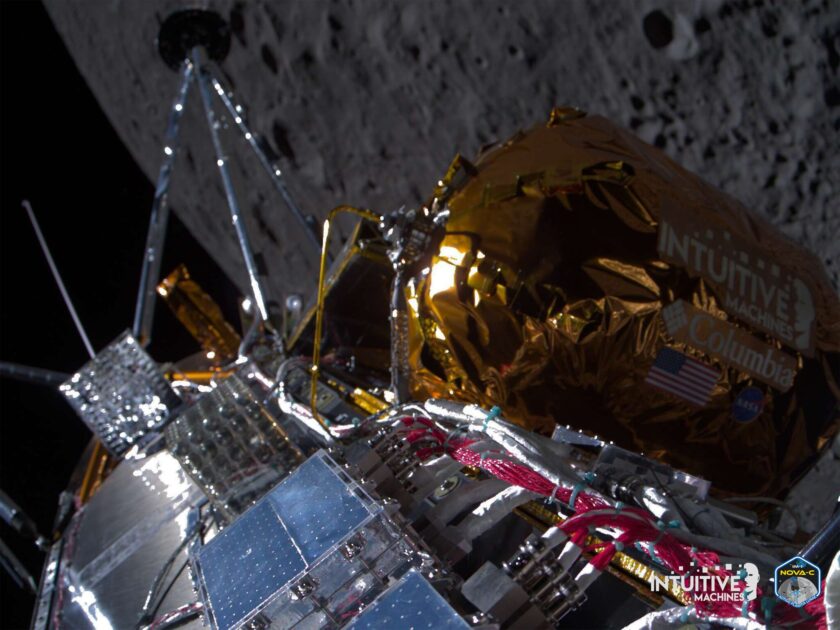
Image credit: IM-1 Lunar Lander in Lunar Orbit. Odysseus passes over the near side of the Moon following lunar orbit insertion on 21 Feb 2024.