PhD candidate SWaPs optical systems for lunar exploration
As a research scientist in defence with a background in maths and chemistry, Cheryl Chan is on a continuous path of learning. A lifelong space enthusiast, Cheryl commenced a PhD in the development of the design and fabrication of freeform optics for compact, low Size, Weight and Power (SWaP) optical systems on small satellites at the University of South Australia (UniSA), a collaboration with Defence Science and Technology Group (DSTG). This also happens to be an iLAuNCH project with industry partners VPG Innovation and SMR Australia.
In this project, Cheryl is investigating the opportunities for additive manufacturing and high-precision technologies to manufacture freeform optical components and systems that are fit to endure launch and space conditions.
To expand her knowledge of space even further, Cheryl applied for and was accepted into the first Australian Milo Mission Academy for Lunar Exploration, in partnership with AROSE which ran from March to June 2024. The academy offered Australian students with a passion for space to participate in internationally recognised space workforce training. The iLAuNCH Trailblazer sponsored students from partner universities to attend this globally renowned program, to prepare the workforce of tomorrow and help grow the space ecosystem in Australia.
What attracted you to the program?
As a part of the iLAuNCH Advanced Manufacturing project at UniSA, I heard that iLAuNCH was supporting a number of students to attend the Milo Mission Academy. Since my PhD project focuses on the design and manufacture of optical systems for payloads on small satellites, the Milo Mission Academy seemed like a great opportunity to understand the greater context of space mission development and design.
What did you learn?
Over the 12 weeks, we had the opportunity to be inspired by experts in the field across a wide range of areas, from technical payload designs, rover designs, to NASA mission development, project management, design and analysis tools and software, and space explorations. Alongside the sessions, we were also given the opportunity to achieve skill badges from extra practical learning videos. The major assignments throughout the 12 weeks consisted of a series of reports, simulating the reviews required in the NASA mission life cycle, building up towards the Preliminary Design Review (PDR) which was 250 pages.
The PDR was an opportunity for our team to present our proposed Shadowed Polar Ice Discovery and Exploration Rover (SPIDER) mission. As the Chief Scientist, I had the opportunity to lead the science team in developing SPIDER’s specific science objectives and payloads that will conduct lunar water-ice mapping in polar Permanently Shadowed Regions. This supports NASA’s goal of having in-situ resource utilisation to provide a sustained human presence on the Moon by 2030, which also contributes towards Artemis III’s objective of understanding the origin and character of lunar polar volatiles.
Supported by a dynamic interdisciplinary team of engineers and programmers, our final risk-mitigated SPIDER rover utilised a unique biomimetic roving mechanism to better traverse the challenging conditions of the lunar environment and terrain, and obtain and analyse valuable subsurface samples. Our design was more than half the size, mass and budget of NASA’s proposed Volatiles Investigating Polar Exploration Rover (VIPER). Unfortunately, despite the originally intended launch at the end of 2024, NASA has since made the decision to cancel the VIPER mission. However, beyond the conclusion of the Milo Mission Academy, the SPIDER team is continuing to look for avenues towards further developing our rover in terrestrial applications.
In my role as the Chief Scientist, I gained knowledge about lunar rover design, the unique considerations required for space and lunar exploration and the importance of science traceability and requirements in every mission decision. I was also exposed to project management and leadership, especially when thrown into a team of very diverse backgrounds (and time zones)! Our multi-disciplinary team consisted of people with expertise ranging from science, engineering and management to law, at all stages of their careers.
Unique experiences in the program
In a project at DSTG, I developed a resolution chart calibration target, inspired by the one used for the Mastercam-Z payload that is aboard the Perseverance rover, currently active on Mars. In doing so, I read numerous relevant reports and familiarised myself with the Mastercam-Z. To my surprise and excitement, it was an honour to have had the opportunity to hear from planetary scientist and Principal Investigator of the Mastercam-Z investigation, Dr Jim Bell, on his experience in working on the project, at one of the Milo Mission Academy seminars.
Would you recommend the program to future participants?
I would highly recommend this program to anyone with an interest in the research or development for any applications in space. The program gives a unique insight into the inner workings, experiences and expectations of developing a NASA mission, directly from the people who currently work there, alongside practical experience for participants to develop their own mission using the skills they attain throughout the course.
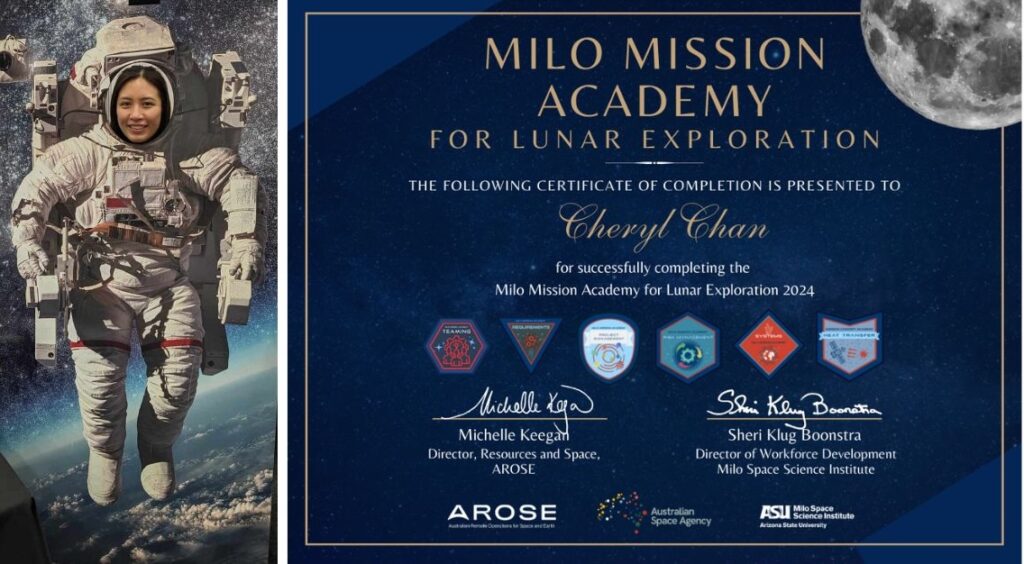
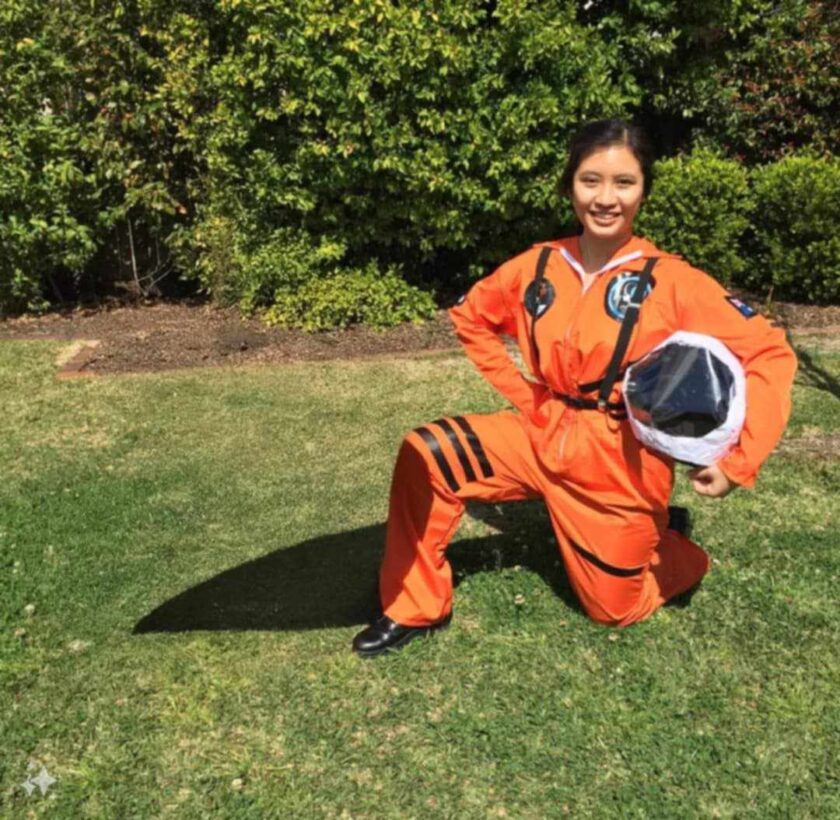
Pictured: Cheryl dressed as an astronaut in Year 12; Cheryl at the Australian Space Forum Adelaide July 2024 and her Certificate of Completion from the Milo Mission Academy.
Why space?
I’ve always had an interest in space at the back of my mind. In fact, I had dressed up as an astronaut on school dress-up day in Year 12 when prompted to dress as what we would like to be “when we grew up”. Then, without actively enrolling myself into a space career, I slowly found myself moving towards one. Now, I am very excited to be developing optical systems that could be launched into space in the near future.
About the program
Providing Australian students with access to space education is a key objective of the iLAuNCH Trailblazer. By facilitating career pathways into the space industry through programs like the Milo Mission Academy in partnership with AROSE, we will provide students with a hands-on, deep-dive understanding of the space mission life cycle, inspiring them to be involved in the space workforce of the future.
More information on the Milo Mission Academy for Lunar Exploration.