
A thrust vector system for guidance, navigation and control on CubeSats
Heralding an era of low-cost space innovation, CubeSats have democratised access to space research with huge benefits to the global space industry. One major drawback of a CubeSat is the lack of size, weight, and power available for subsystems to control the satellite once in space.
The control process of satellite motion, GNC (Guidance, Navigation and Control), determines satellite position, velocity, attitude and rotational rate and is continuous once in space.
This latest iLAuNCH Trailblazer project builds on original work from The Australian National University and Boswell Technologies that launched to space in 2023. The Bogong Thruster is a box containing naphthalene (mothballs) which is a propellant that goes directly from a solid to a gas when heated. By emitting naphthalene gas into space, you create thrust, pushing your spacecraft forward in the opposite direction.
This project will develop a thrust vectoring system for the Bogong Thruster, to advance GNC for CubeSats.
“We are pioneering Australia’s first vectored thrust technology for small satellites, using space heritage demonstrated by iLAuNCH university partner, ANU and Boswell Technologies,” said iLAuNCH Trailblazer Executive Director, Darin Lovett.
“We are partnering with Indian company Azista Industries to integrate the thruster into a CubeSat to demonstrate space flight heritage on orbit. Successful demonstration of this thruster will open it up for commercialisation into the CubeSats and SmallSats that Azista is developing.”

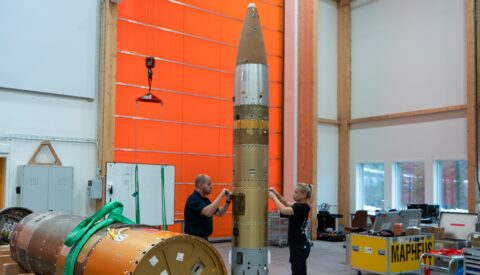
Pictured: ANU Wombat space simulated vacuum chamber side
This cutting-edge system will be integrated into Azista’s attitude control system (ADCS), offering unprecedented precision manoeuvring and responsiveness of small satellites enabling them with new capabilities for applications in Earth observation, secure communications, and optical alignment.
“This project shows how a PhD student’s research at university can be developed into a cutting-edge technology in the space industry. Collaboration between industry and the university resulted in the full development of the Bogong 1 thruster, which is now functioning in orbit. Bogong Thruster demonstrates Australian National Universities capabilities and potential future development of the technologies and can inspire many students and researchers,” said the Australian National University Head of the Space Plasma, Power and Propulsion laboratory, Professor Christine Charles.
This project stands to catalyse the small satellite sector by introducing an advanced vectored thrust control system, marking a significant leap in manoeuvring capabilities.
“The successful demonstration of this technology in orbit will serve as a critical milestone, showcasing the potential for this home-grown innovation to revolutionise small satellite operations and establish new industry standards for satellite control systems,” said Boswell Technologies Chief Executive Officer, Professor Roderick Boswell.
By enhancing the manoeuvrability of small satellites, this project has the scope to stimulate economic growth within the regional satellite and space technology markets.
“Azista will undertake the design and production of the CubeSat, ensuring it is compatible with the integrated propulsion and pointing systems, preparing it for comprehensive altitude/attitude control testing then manage the launch of the satellite into orbit to showcase the technology’s functionality and readiness for the market,” said Azista Industries, Business Development Manager, Bharath Simha Reddy Pappula.
Concept, deformable structure design will be followed by prototyping, testing and integration, that will culminate in the delivery to the launch facility for pre-launch testing and preparation in 2026. Once in orbit, Azista will control the satellite and different mission and test profiles will be performed on the satellite to show the capabilities of the technology.
Pictured: Roderick Boswell, Professor Christine Charles holding the Bogong Thruster and Dr Mahdi Davoodianidalik in front of the WOMBAT
About Boswell Technologies
Boswell Technologies researches, designs and manufactures systems to operate at the frontiers of survival. In space they have two assets circling the Earth at 500km: the Bogong series of solid propellent cold-gas satellite thrusters. On Earth they have Solely Solar, a completely autonomous solar powered van designed for the outback. Our team has close on 100 years of engineering experience from around the world so if it has to work autonomously at the edge of survival, we can do it.
They are a group of engineers/scientists who design, build and commercialise systems that must work reliably and autonomously. Collaborative engagement forms the basis of their philosophy for working with people from all walks of life.
About Azista Industries
Azista Industries Pvt Ltd (AIPL), is a premier technology conglomerate offering services across a wide range of domains, including Aerospace, Composites, Defence, Data Analytics, Food, Healthcare, Surveillance, Satellites, and Satcom. As India’s largest space systems company, Azista boasts an impressive installed annual production capacity of 100 satellites and operates a 50,000-square-foot facility equipped with state-of-the-art infrastructure for the development and manufacturing of highly reliable space systems.
Azista’s significant contributions to various ISRO missions highlight its expertise and commitment to excellence. The company has provided high-reliability (Hi-Rel) electronics for prestigious projects such as Cartosat-3, NISAR, RISAT, and many more.