iLAuNCH – Development and Flight Qualification for an Australian Radioisotope Heating Unit
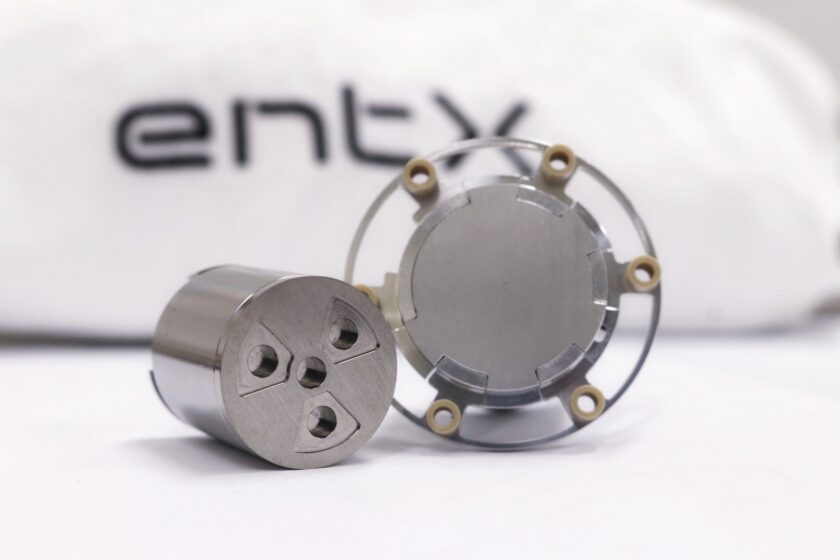
iLAuNCH industry partner entX Limited, led the development and validation of an Australian-made Radioisotope Heating Unit (RHU) and Thermal Management System (TMS) demonstrator for lunar and deep-space missions, in collaboration with the University of South Australia (UniSA). The project addressed a critical challenge in lunar exploration: maintaining spacecraft functionality during the 14-day lunar night, where temperatures can reach -180°C.
The project established a sovereign Australian capability in radioisotope-powered thermal management for future lunar and space missions, commercial space applications (progressing towards US suborbital flights), and future nuclear space technologies. It is also likely to position the project’s legacy ability to deliver one of the first commercial launches of a “Nuclear space system”.
The project was built upon an earlier Australian Space Agency Demonstrator Feasibility Study that identified beta-emitting radioisotopes as a potential basis for an Australian RHU capability. Future lunar missions require reliable thermal energy during the lunar night, which lasts about 14 Earth days and exposes equipment to temperatures approaching -180°C. Solar-powered systems alone cannot provide continuous survival capability during these periods. Historically, RHUs have relied on radioisotopes employing PuO₂ sealed within intricate, multilayer containers. This technology helps keep spacecraft parts functioning smoothly in the vastness of deep space and on planets by offering a reliable heat source that doesn’t depend on sunlight. Although being technically mature, this technology relies on internationally controlled radioisotopes and costly supply chains that are not readily accessible to Australia.
The research combined the delivery of radioisotope fuel development and processing, an integrated thermal management system, radiation shielding and containment technologies, space systems engineering, and flight qualification methodologies. Advancing from an early feasibility concept to a validated demonstrator system to a final TRL 6, establishing a commercialisation pathway to flight heritage for transport companies and lunar/space payload developers.
Some of the current challenges include limited launch opportunities for radioisotope payloads, international launch licensing and regulatory dependencies and scheduling constrains, and testing and vendor availability.
The project facilitated partnerships between the University of South Australia (now Adelaide University), industry partner entX Ltd, as well as government-funded bodies such as the Australian Nuclear Science and Technology Organisation (ANSTO) under the iLAuNCH Trailblazer program. More broadly, beneficiaries of the study are the Australian Space Agency, future lunar mission operators, commercial space firms, defence and national security stakeholders, Australian advanced manufacturing and nuclear technology sectors, and future researchers. Furthermore, the project has contributed to Australian intellectual property, and increased workforce capability in nuclear-enabled space technologies and commercial pathways for industry academic and governmental partners.
Partners
- The University of South Australia – now Adelaide University
- entX
- The University of Southern Queensland – iLAuNCH
About iLAuNCH
The Innovative Launch, Automation, Novel Materials, Communications and Hypersonics (iLAuNCH) Trailblazer is part of Trailblazer Universities Program administered by Australian Government Department of Education. ILAuNCH is led by the University of Southern Queensland in partnership with the Australian National University and the University of South Australia. This program is building Australia’s enduring space capability through the commercialisation of projects, a fast-track accelerator, and skills development to build the workforce of the future. To find out more, visit ilaunch.space.