Space holds the key for hypersonic missile defence
Hypersonic weapons are highly manoeuvrable and designed to avoid detection by traditional missile defence systems such as ground-based radar. Responding to these threats is a global problem.
The past decade has seen substantial progress by many nations in the development of hypersonic systems, posing significant risks to Australia’s interests.
To neutralise the threat posed by near-peer adversaries and maintain a strong regional deterrence posture, Australia must develop sovereign capabilities in counter-hypersonics, with the space domain providing a critical layer for overall missile defence.
“We are bringing together Australian knowhow to build an advanced space surveillance system for missile defence tailored for deployment on small satellites,” said iLAuNCH Trailblazer Executive Director, Darin Lovett.
“Together with industry partners Northrop Grumman Australia and Spiral Blue, we will couple state-of-the-art mission simulation capabilities with pioneering imaging and space edge computing technologies to advance space-based hypersonic vehicle surveillance. Through projects like these, iLAuNCH is significantly contributing to national security and deterrence.”
This mission aspires to cultivate a new sovereign capability for hypersonic missile detection through the fusion of cutting-edge infrared detection technology and industry-leading space-based artificial intelligence (AI) and machine learning (ML) data processing techniques. Anticipated outcomes encompass hypersonic vehicle radiance and trajectory modelling, comprehensive design, and rigorous analysis of an infrared electro-optical system, by leveraging state-of-the-art infrared detectors and space edge AI/ML hardware and algorithms for on-board event detection.
Northrop Grumman’s Parallax Labs will bring the advantages of model-based systems engineering, advanced simulation, and high levels of automation to systems development, integration, and test activities.
“Through mission engineering, we plan to rapidly progress promising future operational concepts up the TRL ladder. We will catalyse the expertise in hypersonic vehicle signatures, space-based detection technologies, and the use of AI/ML techniques for threat identification from our different project partners to inform the development of a discriminating capability to the end user,” said Dr Dushy Tissa, Northrop Grumman Australia’s Technology Outreach Manager.
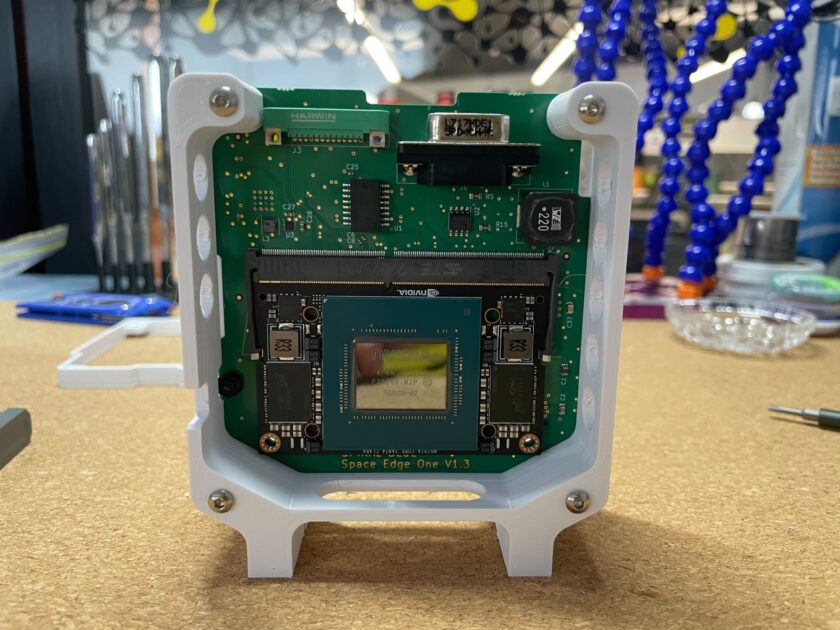
These efforts will leverage Spiral Blue’s edge compute capability which can be reprogrammed over the air.
“We are designing a system that once launched, will be a hypersonic detection research platform that can continuously be updated and improved to account for new types of hypersonic events, all enabled through Spiral Blue’s edge computer,” said Spiral Blue Founder and CEO, Taofiq Huq.
In maturing a full stack missile detection capability, this iLAuNCH Trailblazer project aims to strengthen defence research in Australia. By leveraging competencies across our partners, we aim to achieve a consolidated output to support sovereign national security needs.
About iLAuNCH
The Australian Government Trailblazer Universities Program provides dedicated investment to accelerate Australia’s innovation agenda at speed and at scale.
The Innovative Launch, Automation, Novel Materials, Communications and Hypersonics (iLAuNCH) Trailblazer is a $180 million program building Australia’s enduring space capability through the commercialisation of projects, a fast-track accelerator, and skills development to build the workforce of the future.
About Northrop Grumman
Northrop Grumman is a leading global aerospace and defense technology company. Our pioneering solutions equip our customers with the capabilities they need to connect and protect the world and push the boundaries of human exploration across the universe. Driven by a shared purpose to solve our customers’ toughest problems, our employees define possible every day.
About Spiral Blue
Spiral Blue is a Sydney-based SME that is leading the next generation of on-board processing. The Space Edge Computer enables satellites to unlock a new realm of data processing with artificial intelligence.
Since being founded in 2018, Spiral Blue hardware is already supporting several customer missions to process data on board satellites for varied use cases. The success of the SE-1 computer has made Spiral Blue the first Australian company in history to develop and operate AI hardware in space. This also paved the way for the YCIS program – the first of its kind in Australia – that allows users to test their code in space. Spiral Blue has previously launched three SE-Z prototypes, with an additional eight SE-1 computers scheduled for launch in 2024, bringing the total number of computers in orbit to twelve.
Image: Spiral Blue Space Edge One