iLAuNCH researcher selected for Tall Poppy Award
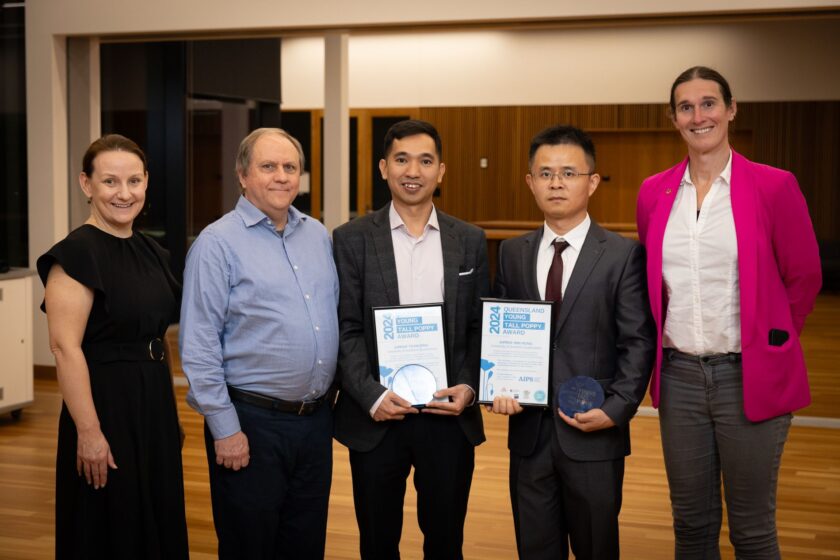
Associate Professor Min Hong from the University of Southern Queensland has been recognised for his outstanding research and science communication at the 2024 Queensland Young Tall Poppy Science Awards.
Professor Hong leads the iLAuNCH project that aims to develop high-performance thermoelectric materials and components for Radioisotope Thermoelectric Generator (RTG) technology.
“My research studies the inefficient use and loss of heat energy in industrial processes, vehicles, and electronic devices, which addresses a critical issue in sustainable energy,” said Professor Hong.
“Despite significant advancements in technology, a substantial amount of the energy consumed in these applications is wasted as heat, representing a financial loss and contributing to environmental pollution through increased fossil fuel consumption. Thermoelectric materials uniquely can convert waste heat directly into electricity.”
Associate Professor Hong said his research supports global efforts to reduce reliance on fossil fuels.
“Australia is experiencing a growing demand for energy due to population growth, industrial expansion, and increased usage of electronic devices,” he said.
“In my research, enhancing energy efficiency and harnessing waste heat can alleviate the pressure on the energy supply and reduce the need for new power generation infrastructure. I’m exploring if these novel materials and innovative fabrication techniques can operate effectively across a wider range of temperatures and in more diverse applications. My focus is on transitioning from laboratory-scale experiments to industrial-scale production, which is critical for the practical application of thermoelectric technology.”
Associate Professor Min Hong was among 16 Queensland scientists honoured at the award ceremony in Brisbane on Thursday August 15. The annual awards, which celebrate scientific excellence, are hosted by the Australian Institute of Policy and Science (AIPS) in partnership with the Office of the Queensland Chief Scientist.
We asked Professor Hong a few questions about his work that has led to such a wonderful achievement.
Congratulations on winning the 2024 Tall Poppy Science Award! Can you share a bit about your journey in science, your involvement with the iLAuNCH Trailblazer and what this recognition means to you?
I have been in thermoelectric research since 2012. I obtained my PhD degree from the University of Queensland in 2016. With an extra four years of postdoctoral training at UQ and UniSQ, I acquired rich experience in SEM/TEM characterisations, MATLAB modelling, first-principal calculations, and finite elemental analysis simulations. In 2020, I obtained an on-going lecturer position at UniSQ and was then promoted to associate professor in the end of 2022.
Through iLAuNCH, my research group aims to develop high-performance thermoelectric materials and components for Radioisotope Thermoelectric Generator (RTG) technology. RTGs have been used successfully in several space missions, including the Voyager mission, the Mars Science Laboratory, and the New Horizons mission to Pluto. In each case, RTGs provided reliable and consistent power for the duration of the mission, enabling the spacecraft to carry out detections and transmit data back to Earth. Future deep-space missions demand to further decrease the weight and improve the power density of power sources. In this regard, it is highly necessary to enhance the energy conversion efficiency and output power of thermoelectric devices, which can serve as powerful electricity generators for the next-generation RTGs. The project will encompass three main work packages (WPs). WP1 focuses on the development of high-performance materials and synthesis methods. WP2 focuses on the radiation testing, shielding, and assembly of thermoelectric components for RTGs. WP3 focuses on the demonstration and validation of these components in simulated RTG systems.
This award recognises young researchers for their excellence in research, scientific achievements, and community engagement. Winning this award signifies that my contributions in research are not only innovative and impactful but also acknowledged by the broader scientific community in Queensland. It emphasises my role as a leader among young researchers and highlights my potential to inspire others within and outside of the scientific community.
Your work has clearly made a significant impact in your field. What inspired you to pursue this area of research, and what challenges did you face along the way?
My interest is driven by the curiosity of exploring the physical/chemical fundamentals on transport properties of charge carriers and phonons. I am also keen on the promising applications of this thermoelectric technology. My research covers materials synthesis, device fabrication, electron microscopy characterizations, theoretical modelling and calculations, and finite element analysis simulations.
My main challenges are balancing Research and Teaching.
Can you discuss a specific project or finding from your recent work that you’re particularly proud of? What are its potential implications or applications?
I am proud of the project I have with iLAuNCH. The high-level purpose of this project is to significantly improve the efficiency and output of RTGs by developing high-performance thermoelectric devices. This will have significant benefits for space exploration and related industries, as it will allow for more reliable and consistent electrical power for deep space probes. The project will also contribute to scientific knowledge and advance our understanding of thermoelectric performance.
Can you share about your experience leading an iLAuNCH project and working with the iLAuNCH Trailblazer?
In the iLAuNCH program, we work with industry partner, entX Limited, who provide support to our research. We appreciate the contributions from entX Limited. It is a great pleasure to work with the iLAuNCH team. I receive prompt replies to my questions, and they are kind, professional and proactive.
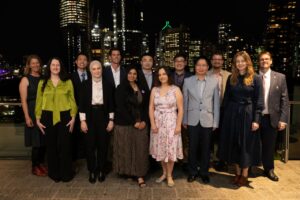
We congratulate Associate Professor Min Hong and the other recipients on their remarkable achievements.